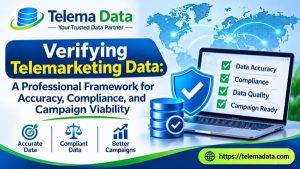
Outbound calling campaigns succeed or fail on the quality of their contact records. Yet many organizations buy telemarketing databases without any structured check. This article gives professionals a practical framework to verify telemarketing data before purchase and throughout the campaign lifecycle. It covers sample testing, provenance and consent review, suppression list checks, and scheduled re-validation. The discussion targets data managers, compliance officers, and sales operations staff who need evidence-based criteria for judging telemarketing data quality.
Introduction
To verify telemarketing data means to test purchased contact records before anyone dials them. It means refusing to accept vendor assurances at face value. This distinction matters. Connect rates on generic B2B lists typically fall between 8% and 12%. Data decay can erode list accuracy by up to 70% each year in some segments. These figures turn the buying decision into a question of verified usability, not record volume.
Verification works best as a lifecycle discipline, not a single quality check. It starts before purchase. It continues through campaign preparation. Its extends into periodic re-validation of aged records. Teams that verify telemarketing data systematically protect agent productivity, cut regulatory exposure, and spend budget on records they can actually reach.
Why Organizations Must Verify Telemarketing Data Before Purchase
Vendor accuracy claims are hard to judge without direct inspection. A structured sample test gives buyers the strongest evidence available before a bulk order. Request 100–250 records and score five dimensions by hand: employer accuracy, title accuracy, direct-dial presence, duplicate rate, and connect outcome.
Employer accuracy should exceed 90% for current employment status. Title accuracy should exceed 85%. Duplicate rates above 5% signal poor data hygiene. Buyers must separate direct-dial coverage from switchboard numbers, because switchboards sharply reduce the odds of reaching a decision-maker. Connect rate offers the most direct usability signal, though it costs more to measure. A sample that performs well below the 8–12% baseline warrants caution.
This testing phase also reveals how a vendor operates. A provider that declines sample requests, or sends a sample unrepresentative of the full dataset, has told you something useful. Teams that verify telemarketing data at this stage avoid the costlier option: finding quality defects after full deployment.
Provenance, Consent, and Suppression: The Compliance Side of Verification
Accuracy alone does not make a dataset usable. Telemarketing regulations, including the Telephone Consumer Protection Act in the United States and the General Data Protection Regulation in the European Union, place duties on the calling party. A data vendor cannot absorb those duties for you. To verify telemarketing data properly, buyers must assess provenance: how the vendor sourced the contacts, whether consent status is documented, and whether record-level suppression history exists.
The FTC’s Telemarketing Sales Rule requires five years of retained call records, consent documentation, and Do Not Call compliance evidence. California’s Delete Request and Opt-out Platform (DROP), live since August 2026, imposes ongoing suppression duties on data brokers. Brokers must process deletion requests and recheck them at intervals of no more than 45 days. A dataset bought without documented provenance therefore creates compliance exposure long after the transaction closes.
Practical steps include cross-referencing records against the National Do Not Call Registry and internal suppression lists before every campaign, not just at purchase. The FTC registry held roughly 254 million active registrations as of late 2024, and that number keeps rising. Treat any vendor that cannot show routine suppression list integration as unsuitable for regulated outbound work. Organizations seeking organized database options for business outreach can consult Best Database for structured solutions. Vendors such as Telemarketing Data state that their records follow GDPR, CCPA, and do-not-call compliance practices and receive periodic suppression updates. Buyers should still verify such claims independently.
Re-validation: Sustaining Data Quality After Acquisition
A purchased list does not hold its quality over time. B2B contact data can decay by up to 70.3% per year through job changes, company closures, number reassignments, and disconnections. A list that tested well at acquisition may lose much of its value within six months.
To verify telemarketing data on an ongoing basis, schedule re-validation around campaign velocity. High-volume outbound teams need quarterly re-checks at minimum. Teams dialing high-value segments intensively should validate monthly. Automated verification workflows, whether inside a CRM or a dialer platform, cut the manual burden. The goal is not permanent accuracy, which no one can achieve. The goal is keeping unusable records within tolerable limits at every campaign launch.
Ongoing verification also supports compliance. Reassigned numbers carry particular risk. A call to a number now belonging to a different person may count as a wrong-party contact under TCPA and similar statutes. Verification services that flag reassigned numbers before dialing reduce that exposure.
Conclusion
To verify telemarketing data is to treat data quality as an auditable, repeatable process rather than a vendor promise. This framework rests on three pillars: pre-purchase sample testing, provenance and suppression review, and scheduled re-validation. Together they give professionals the evidence to separate campaign-ready records from nominal deliveries. Neglecting this discipline carries well-documented costs: wasted agent time, lower connect rates, and regulatory penalties. For anyone responsible for outbound strategy, systematic verification is a core operational requirement, not an optional refinement.